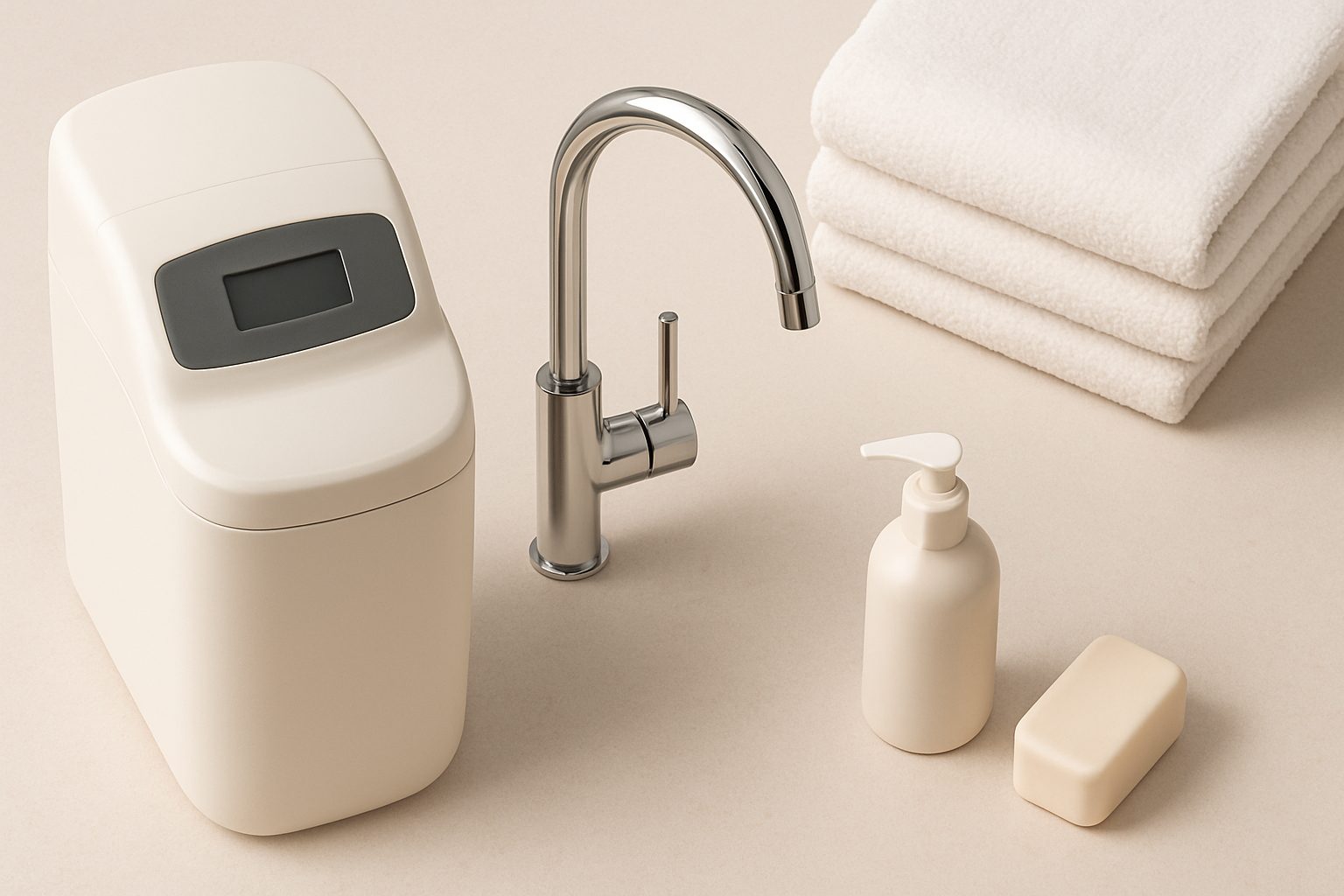
Water Softener vs Water Conditioner UK: What's the Difference?
If you've got hard water at home, you'll have come across both water softeners and water conditioners. They sound similar, but they work in completely different ways—and choosing between them depends on what you're trying to solve.
Hard water affects roughly 60% of UK homes, particularly in the Midlands, South East, and Yorkshire. The dissolved minerals—mainly calcium and magnesium—leave limescale on taps, reduce soap effectiveness, and damage appliances over time. Both softeners and conditioners tackle this problem, but they approach it from opposite directions.
How Water Softeners Work
A water softener actively removes hardness minerals from your water. The most common type uses a process called ion-exchange. Inside the softener's resin tank, beads are coated with sodium ions. As hard water passes through, the calcium and magnesium ions swap places with the sodium—they stick to the resin, and sodium goes into your drinking water. You end up with genuinely soft water.
The resin eventually becomes saturated and stops working. When this happens, the system automatically regenerates by flushing the tank with a strong salt solution (brine). This strips off the trapped minerals and replaces them with fresh sodium. The wastewater (called brine discharge) goes down the drain.
So water softeners need regular salt top-ups—a bag every 4–8 weeks depending on water hardness and household size. For a three-person household with moderately hard water, you're looking at around £100–£150 per year in salt costs.
How Water Conditioners Work
Water conditioners don't remove hardness minerals at all. Instead, they prevent those minerals from causing problems. The most common approach is called scale inhibition. The system doses your water with a small amount of chemical (typically polyphosphate or citric acid) that stops calcium and magnesium crystals from bonding together. The minerals stay dissolved and pass through your pipes harmlessly.
Some water conditioners work differently—electromagnetic or magnetic devices claim to alter how minerals behave. These are less scientifically proven than chemical dosing, but some people report benefits. Salt-free softeners (which use potassium chloride instead of sodium chloride) also fall into this broader category of "conditioners" in the sense that they don't soften your water in the ion-exchange way.
A key difference: the water coming from a conditioner is still hard. It contains the same mineral content. It just won't scale up your kettle or block your shower head.
Effectiveness: What Each One Actually Does
Water softeners genuinely soften water. Your kettle stays clean. Soap lathers properly. Your skin feels less dry. Washing machines and dishwashers last longer. If limescale buildup is your main problem, softeners solve it completely.
Water conditioners prevent scaling but don't provide these secondary benefits. Your water is still hard—soap won't lather as well, and you may still notice a slight dryness. However, for the primary issue (limescale), a chemical dosing conditioner is typically 90–95% effective. Kettles, taps, and shower heads stay largely scale-free.
Installation and Space
Water softeners need a dedicated tank (usually 60–80 cm tall), a brine tank, and a drain nearby. If you've got a utility room or under-sink space, this is manageable. Installation takes a plumber a few hours.
Conditioners are usually much smaller—a compact cartridge system or a small box that sits under the sink or on a shelf. Some take up minimal space. Installation is quicker and sometimes DIY-friendly.
Operating Costs
Salt-based softeners: £100–£150 annually in salt, plus occasional cartridge replacements (every 5–10 years, £150–£400).
Chemical dosing conditioners: typically £80–£120 per year in cartridge replacements, with no salt needed.
Electromagnetic conditioners: no consumables, just electricity (negligible cost).
Maintenance and Mess
Softeners require regular salt deliveries and occasionally need brine tank cleaning. There's a workflow involved. They also slightly increase sodium intake in your drinking water, which matters if you're on a sodium-restricted diet.
Conditioners need less hands-on management. Chemical systems need cartridge swaps but that's straightforward. Electromagnetic systems barely need any attention.
The Trade-off: The Real Difference
This is the honest bit. A softener gives you genuinely soft water but requires salt, space, and ongoing maintenance. A conditioner gives you hard water that won't scale—which solves the limescale problem but not the hard-water feel.
For most UK homes, the right choice comes down to what bothers you most. If you hate limescale and don't mind your water staying hard, a conditioner is cheaper to run and easier to live with. If you want truly soft water and have the space and budget, a softener is the more thorough fix.
Which Should You Choose?
Softeners suit households with very hard water (above 200 mg/L), significant limescale issues, or where soft water feel matters. They're the gold-standard solution if space and cost allow.
Conditioners work well for moderate hardness (100–200 mg/L), renters, or anyone who wants to solve scaling without full softening. They're more straightforward to maintain and less intrusive.
Check your local water hardness first—your water company will tell you. Then decide whether you need minerals removed entirely or just prevented from causing damage.
More options
- Amazon UK — Salt-Based Water Softeners (Amazon UK)
- Amazon UK — Salt-Free & Magnetic Water Conditioners (Amazon UK)
- Amazon UK — Water Softener Salt Blocks & Tablets (Amazon UK)
- Amazon UK — Water Hardness Test Kits (Amazon UK)
- Harvey Water Softeners & BWT UK — Brand Affiliate (Amazon UK)