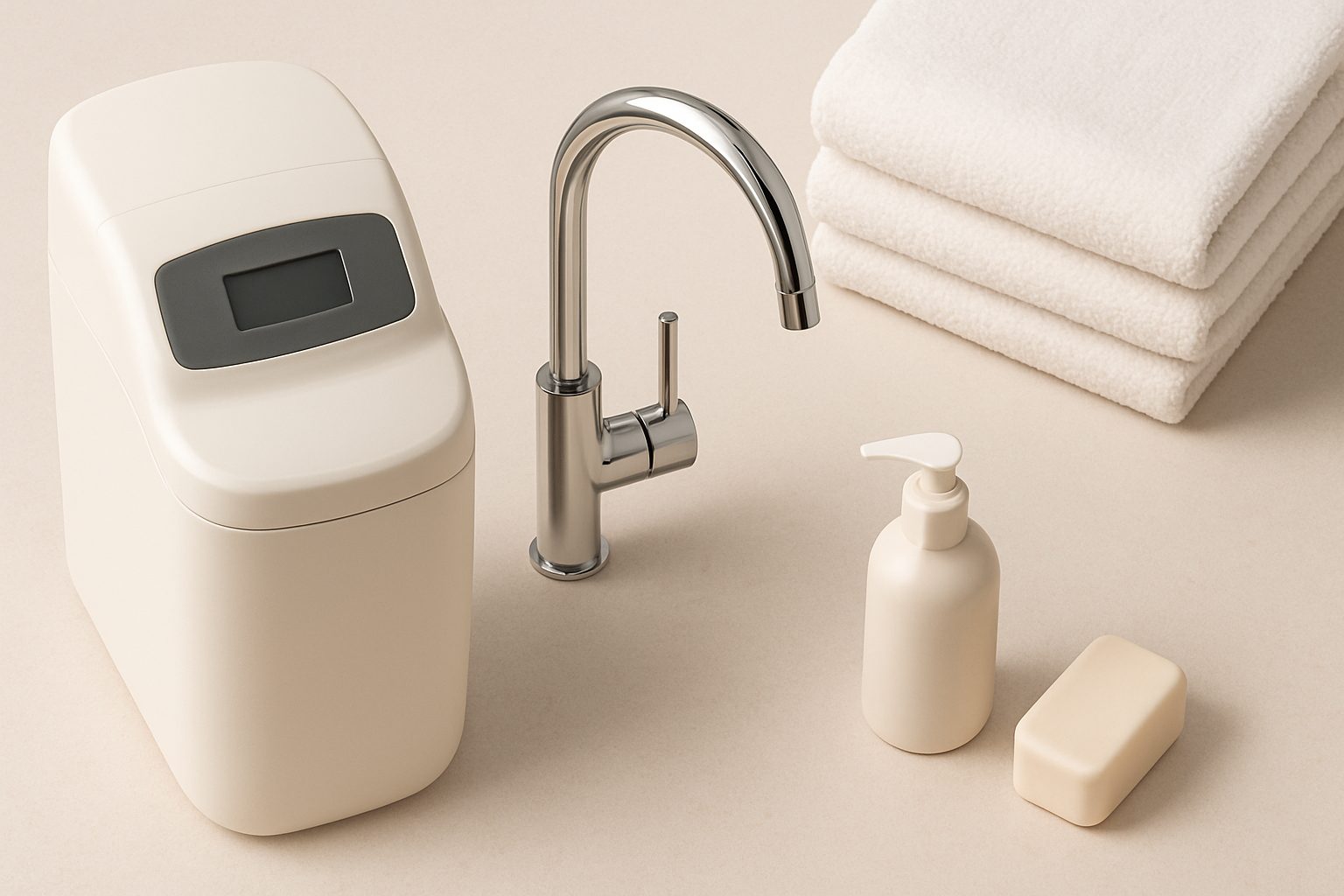
Best Water Softener for a 4-Bedroom House UK (High-Capacity Picks)
Hard water is a genuine problem in most of the UK. Limescale clogs shower heads, shortens appliance life, and leaves soap scum on bathrooms. For a 4-bedroom household with multiple bathrooms and regular laundry, a properly sized water softener makes a real difference—but only if it has enough capacity to handle your actual water use.
This guide focuses on high-capacity systems: twin-tank softeners and demand-initiated models that regenerate based on usage rather than a fixed schedule. These suit larger homes better than compact point-of-use units.
Why Capacity Matters for a 4-Bedroom House
A 4-bedroom home typically has 2–3 bathrooms, possibly a dishwasher, and regular family laundry. Daily water consumption can easily reach 300–500 litres, especially with teenagers and multiple occupants.
Water softeners work by exchanging hardness minerals (calcium and magnesium) for sodium on resin beads. Once the resin is saturated, the system needs to regenerate—flushing salt brine through the tank to reset it. If regeneration happens too frequently or at the wrong times, you'll run out of softened water mid-week or mid-shower.
Most softeners are rated by grain capacity: how many grains of hardness they can remove before needing a flush. For hard water areas (anything above 250 mg/litre, which includes much of the UK Midlands, South, and East), a 4-bed house typically needs 40,000–60,000 grain capacity, or ideally two independent units working in series or rotation.
Single Large-Tank vs. Twin-Tank Systems
Single-tank softeners are cheaper upfront but have a critical flaw: regeneration takes 30–60 minutes, during which no softened water is available. In a busy 4-bed house, this usually happens at an inconvenient time—often early morning when someone's showering.
Twin-tank (parallel) systems have two resin tanks that alternate. While one regenerates, the other supplies softened water to the house. You get continuous soft water 24/7. The trade-off is cost—roughly 30–50% more than single-tank models—and space (they're bulkier).
Demand-initiated systems fall somewhere between. They monitor water usage and only trigger regeneration when resin capacity actually drops below a threshold. This reduces salt and water waste compared to time-scheduled regeneration, and often avoids peak-use times.
What to Look for
Grain capacity: Aim for 40,000–60,000 grains for typical hard water. If your water authority reports hardness above 350 mg/litre, consider the upper end or twin-tank.
Resin quality: Modern ion-exchange resins last 10–15 years on average. Cheaper systems may use lower-grade resin that degrades faster, especially in chlorinated mains water.
Regeneration frequency: Check the spec sheet or ask the supplier to calculate this for your postcode and household size. Frequency affects running costs (salt and water) and convenience.
Bypass valve: Critical safety feature. Allows the system to supply unsoftened water if it fails, preventing you from having no water at all. Always insist on this.
Salt consumption: A 4-bed system typically uses 60–150 kg of salt per year. Twin-tanks and demand systems often use less than time-scheduled equivalents, offsetting the higher capital cost.
Top Models for 4-Bedroom Homes
BWT whole-house softeners are common in the UK market. Their larger models (typically Aquadial or Perla ranges) offer 40,000–50,000 grain capacity and simple metered regeneration. They're reliable and widely available via Amazon UK, though the cabinet design is functional rather than minimal.
Monarch systems focus on twin-tank options, which suit larger households well. Their dual-resin setup ensures continuous supply and is ideal if regeneration downtime is a genuine concern. They're pricier but perform excellently in hard water areas.
Fleck produces commercial-grade demand-initiated softeners (often badged under other brand names in the UK). These use sophisticated monitoring to regenerate based on actual water use, not a fixed timer. More efficient than time-scheduled systems, though the upfront cost is higher.
Running Costs
Beyond the initial purchase (typically £1,500–£4,000 for quality twin-tank systems), expect:
- Salt: £30–80 per year depending on water hardness and system efficiency
- Electricity: Minimal (£10–20 yearly for the control valve and pump)
- Resin replacement: £100–300 every 10–15 years
- Annual servicing: Optional, £100–150 if contracted
Twin-tank systems often cost slightly more to run than single-tank (extra electricity, possibly more salt) but avoid the inconvenience and water waste of frequent planned downtime.
Installation Considerations
Professional installation is strongly recommended for 4-bed homes. Expect £300–800 depending on your pipework layout. Softeners must be plumbed after the mains stopcock (so the external tap retains unsoftened water) and ideally with a bypass so maintenance won't leave you without water.
Some areas require Building Control notification. Check with your local authority before buying. Most systems qualify as non-regulated under current standards, but rules vary.
The Honest Drawbacks
Water softeners aren't perfect. Softened water lacks the minerals some people prefer for taste—though this is subjective. You'll still need to clean limescale periodically from kettle spouts and showerheads (prevention is easier, but not elimination). They also add sodium to your water, which concerns some people on salt-restricted diets, though the amounts are usually negligible for a whole-house system versus processed foods.
In very soft water areas (below 120 mg/litre), softening isn't necessary and wastes money. Check your local water authority's hardness data first.
Conclusion
For a 4-bedroom UK home in a hard water area, a twin-tank or demand-initiated softener with 40,000–60,000 grain capacity will handle everyday use without the inconvenience of mid-cycle regeneration. BWT, Monarch, and Fleck models represent solid choices across different budgets and philosophies. Prioritise grain capacity over brand hype, ensure a bypass valve is fitted, and get a professional installation.
More options
- Amazon UK — Salt-Based Water Softeners (Amazon UK)
- Amazon UK — Salt-Free & Magnetic Water Conditioners (Amazon UK)
- Amazon UK — Water Softener Salt Blocks & Tablets (Amazon UK)
- Amazon UK — Water Hardness Test Kits (Amazon UK)
- Harvey Water Softeners & BWT UK — Brand Affiliate (Amazon UK)